


Light Action in the Caribbean
by Barry Lopez. Vintage, 2001. 162 pages.
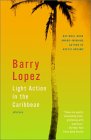
Light Action in the Caribbean is a slim collection of stories whose lyricism, solemnity, and attention to the nuances of language sometimes make it read like a talented young writer's first book. But the historical depth of these stories, the range of experience they contain, and what one can only call their wisdom make it plain that this is the work of a seasoned author.
Barry Lopez is best known as a nature writer and the author of the monumental Arctic Dreams, but he has actually produced more volumes of fiction than anything else. In his stories, as in his essays and travel writing, the descriptions of the natural world are exceptional:
What drew me to reflect on the orchards where I now live was the stupendous play of light in them, which I began to notice after a while.... Sometimes after a snow the light in the orchards at dusk is amethyst. In spring a gauze of buds and catkins, a toile of pale greens, closes off the sky. By summer the dark ground is laid with shadow, haunted by odd shafts of light. With fall an elision of browns -- the branches now hobbled with nuts -- gives way to yellowing leaves. And light again fills the understory.
Nature is never just picturesque in these stories. It is the key to the characters' understanding of themselves, and if attended to closely it can be the doorway to new dimensions of reality. Like Evan Connell, another erudite writer of the West with a lapidary style and a deep sense of history, Barry Lopez senses mysteries behind the appearances of everyday life.
The prototypical hero of a Barry Lopez story is a quiet, humble, yet highly skilled man whose attention to his craft breaks through the boundaries of the ordinary. In "Emory Bear Hands' Birds," a Native American convict teaches his fellow prisoners how to discover their animal totems, and ultimately find a way out. In "The Construction of the Rachel," an abandoned husband, seeking refuge in the silence of a Benedictine monastery, builds a model ship more perfectly than he realized. "In the Great Bend of the Souris River" tells of a wandering house builder who is called back by an irresistible impulse to the high plains of North Dakota where he grew up. Alone one day on horseback near the Canadian border, he meets two horsemen who speak a language he doesn't know, and whose faces and bodies are painted like the Assiniboin people who lived there two hundred years before.
Oddly enough, it is the title story of this collection, "Light Action in the Caribbean," that breaks the mold. The main characters of this merciless tale are a couple vacationing in the islands. The husband is arrogant and condescending, the wife grasping and superficial, but although neither one is at all agreeable, the reader may feel that they don't entirely deserve the shockingly violent fate that awaits them -- made even more shocking by the crisp, detached authority of Lopez's perfect sentences.
Review by Geoff Wisner
Published in the Harvard Post, March 9, 2001.