


Best Nightmare on Earth
by Herbert Gold. Prentice Hall Press (Simon & Schuster), 1991. 303 pages, $19.95.
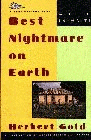
Here is a book about Haiti which not only is not depressing (though, especially toward the end, it can be quite sad) but is warm, engaging, and often funny. Herbert Gold, who has known Haiti from the "golden age" of the 1950s through the brutal and greedy regimes of Papa Doc and Baby Doc and the chaos that followed them, has entered into Haitian life and observed the country and its people with enormous sympathy.
Best Nightmare on Earth is generous, humane, puckish, inventive, lively, and nostalgic. Gold, best known as a novelist, packs his language with pleasantly unexpected turns of phrase, whether his own or those of other people. A man named Ti-Roro, he says, "played the drums and the buffoon for tourists." A radio announcer reports after a riot that "several people were injured not up to the point of being considered dead." And Gold's old friend Jean Weiner remarks to him, "We have a two-party system, mon cher. One in the palace and the other in the cemetery."
Like many good books, this one is tricky to define: part history, part memoir, part cultural study. Gold describes cockfights, werewolves, Graham Greene, the "lithe and blithe" Aubelin Jolicoeur (the model for a character in Greene's The Comedians, as he never tires of telling people), and the ways in which Haitians, the poorest people in the Western Hemisphere, manage to survive -- whether as poets or anthropologists, or by gluing together Tiffany lampshades.
Gold is less inquisitive about voodoo and the phenomenon of zombies than some other writers have been. Zora Neale Hurston, in Tell My Horse, described having met and photographed a zombie -- a woman who reappeared and was identified by friends and neighbors many years after her death and burial -- and speculated that zombies are created at least in part by drugs that simulate death and then keep the victim in a dull trancelike state. Wade Davis, in The Serpent and the Rainbow, claimed to have identified the drug that creates zombies.
Gold's approach is fairly matter-of-fact. "Zombies looked to me," he says, "like what others might call catatonic schizophrenics. They are pretty depressed, unavailable to the normal human pleasures, such as gambling, loafing, singing, or lovemaking." From what I take to be a dismissive reference to The Serpent and the Rainbow as "a sensational American book" (it is sensational, and clearly "improved" by fictional techniques, but it is still quite fascinating) Gold doesn't put much stock in the zombie-drug theory.
He does take the supernatural seriously as an indicator of social conflicts. "Haitian loupgarous are not werewolves in the European tradition," he says. "They are once-human beasts whose souls have been devoured. The demons continue to use the bodies of men when it serves their purposes. Your best friend might turn out to be a loupgarou, which sometimes accounts for deceit and betrayal. An unworthy neighbor gets rich while the rats are eating your corn? He's a loupgarou.... Black magic helps to explain injustice. Therefore it also helps to preserve the sense that justice exists, is even possible for poor people."
Some of Gold's favorite observations appear more than once, but rather than being annoying, the recurrences act as refrains. They include the picture of Harold Stassen, clipped from a magazine, that stands in for a Haitian god on a voodoo altar; the taunting reference to the Place des Heros as the Place des Zeros; the old description of mountainous Haiti as having been crumpled in God's hand; the French toast at the Grand Hotel Oloffson; and the distinctive Haitian pigs, which Gold at first took to be "exceptionally quick, agile, intelligent, and curious little black dogs." By the time Gold describes the "pig pogrom," when American experts tried to eradicate the little Haitian pigs, it is easy to understand how deeply this disrupted the lives of the peasants. The American pigs brought in as replacements "couldn't be led to market on a string. They weren't cute, they weren't voodoo-effective, they weren't the pig of myth and dream."
It is good to see that Prentice Hall and its designers have taken the trouble to make this book appealing to look at as well as to read. The jacket is taken from a painting by the Haitian artist Andre Pierre, and each chapter is introduced with handsome display type and ornamented with a stylized gecko lizard. Altogether, Best Nightmare on Earth is a graceful and moving homage to the Haitian people, in whom even today "something tough, resilient, ironic, and brave seemed to persist -- that Creole wit, that grace under suffering, a rich artistic energy, a poignant religious expressiveness in voodoo, a nervous edge of continual risk-taking. The soul of Haiti was still captivating. Others who have done their time in Haiti understand this passion. It is very like love."
Published in the Harvard Post, March 20, 1992.