


Through the Ivory Gate
by Rita Dove. Pantheon, 1992. 278 pages, $21.00.
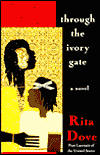
In keeping with the book's decorative typeface and striking black-and-gold jacket, the language of Through the Ivory Gate -- the first novel by the poet Rita Dove -- is often very pretty. As one might expect from a poet, Rita Dove excels at atmospherics: weather, dreams, moods, and music. But in a perverse way, the novel's main problem is that it is sometimes too pretty. When the urge to create beautiful setpieces wins out over the urge to express what are often painful truths, the writing can become coy and precious rather than sharp and lyrical.
Through the Ivory Gate is the story of Virginia King, an African-American woman who grows up in Akron, Ohio, moves with her family to Arizona, studies the cello at college in Wisconsin, lives and works for a time with an experimental, left-wing puppet troupe, then returns to Akron through an artists-in-the-schools program. One way to read it is as the story of a young black woman who wants to live a life unconstrained not only by white racism but by the expectations of her family and other blacks. Early in the book, Virginia throws her new doll out the window -- not because it is black, as her horrified mother suspects, but because it is poorly made and ugly, and because she loves the long red hair of her other doll. She dreams of running down a street with red hair streaming behind her, but in the dream her skin is still dark. Later in life, Virginia stubbornly resists her mother's desire that she "advance the race" by becoming a "professional." At the same time, she bristles at any suggestion that it is inappropriate for a black woman to be an actress, or a mime, or a cellist, or a puppeteer.
Another way to read the book, one that would account for some of its idealizing tendencies, is as the story of a woman who lives too much through art and romantic fantasies, and must learn to see life more clearly. A fellow puppeteer, a white man named Parker, quotes her the image from Homer that gives the book its title: "Two gates for ghostly dreams there are: one gateway of honest horn, and one of ivory. Issuing by the ivory gate are dreams of glimmering illusion."
"Illusion, Virginia," Parker goes on. "Glimmering illusion. That's all we're doing. We're playing with shadows, pretending they'll come to life with the first rays of the full moon. And we learn to do it so well that other people believe in the shadows. But do you know what? To the others, the shadows are real. Only to us they're not." Virginia, often self-absorbed, never reflects on this idea. She is too preoccupied with wondering whether, as Parker asks her in the same conversation, she has ever done anything impulsive in her life.
Virginia King is a bit of a cold fish. She is slow to trust people, a little standoffish. Some of the things she says, especially to her pupils and their parents, are so refined and bookish as to strain belief. But she is also a dedicated artist and teacher, a seeker and a romantic. Lovers of the romantic will enjoy this book, especially if they don't mind when it verges on sentimentality. Here is Virginia with her cello:
The A string had to be tuned a whole step down to G, subduing the tone and making the harmonies more forlorn, more compressed, as in church hymns. She kept missing notes and had to fudge a bit to get the chords in tune, but beneath the slippage was the true music that gripped and made pride bow down before the monumental sadness of being alive, music that required no explication, no translation: dissonant, unresolved, the music of a human being probing the darker corridors of the unachieved. The chords were so tightly knit they seemed to bend, like blue notes in jazz, or a train whistle in the dead of night, scrawling its grief across the darkened landscape.
This kind of lyricism is risky, but when it comes off, the effect can be breathtaking. The mannered passages that mar this novel would not be so glaring if the good parts were not so good.
Published in the Harvard Post, February 26, 1993.