


The Medusa Frequency
by Russell Hoban. Atlantic Monthly Press. 143 pages, $16.95
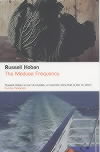
Early in this brilliant, funny, and thoughtful novel, someone mentions a movie called Codename Orpheus. "Is it a spy film?" asks the hero, a failed novelist turned comic-book writer named Herman Orff. No, says his friend, "more of an existential exploration of the nature of reality." The title of the novel itself is, probably by design, just as misleading. The Medusa Frequency sounds like a thriller by Robert Ludlum, but it is actually the latest in a series of increasingly ambitious works by the British novelist Russell Hoban, formerly a writer of children's books. As in Turtle Diary (made into a film with Ben Kingsley and Glenda Jackson), we see Londoners leading gray, unsatisfying lives in rented rooms. In both books the heroes find release through an unusual, even desperate act. In Turtle Diary a man and a woman kidnap sea turtles from an aquarium and release them into the ocean. In The Medusa Frequency the hero, responding to a flyer entitled "Head for it!", has his brain stimulated by electrodes. This treatment is advertised as a cure for "artistic problems," but its most striking result is that Herman Orff discovers -- or hallucinates -- a decomposing human head on the banks of the Thames. Orff (not squeamish) picks it up, the head explains that it is the head of Orpheus, and begins to tell its story.
Heads are a major theme in the book. Herman Orff (whose name alludes to Hermes and Orpheus) uses his computer to conduct a dialogue with the Kraken, a kind of giant squid, or huge head with tentacles. Orff's apartment is decorated with reproductions of Vermeer's Head of a Young Girl, a painting he eventually travels to Holland to see. He doesn't find the painting, but does meet Gosta Kraken, a filmmaker whose large bulbous head and drooping mustache give him a squidlike appearance. Kraken is the director of Codename Orpheus, which includes a scene showing the head of Orpheus floating up a river, against the current.
Playful though all this is, Hoban doesn't import giant squids and Greek mythology into modern London just for the humor of it, and the novel rarely descends into camp. Each figure has a modern significance that resonates for Orff and for the reader. Hermes, for instance, is not some "bloke with winged sandals" but instead "the thief-god, the god of roadways and night journeys, the god of here-and-gone, the easer through the shadows, the finder in the dark." Even more basically, he is a principle of evanescence and change, "a shift in the relativities of the moment, a new disposition of energies."
Orpheus is even more various than this. He is not only the symbol of lost love, but of the singer, the artist. Appearing to Orff as a cabbage, a soccer ball, and finally a halved grapefruit, he unfolds his tale in installments, each one a piece in the puzzle of Orff's own artistic and romantic frustration.
"Tell me about Luise. What was the idea of her?""What an odd question."
"It came to me," said the head, "that when people fall in love they entrust to each other the idea of themselves."
"Do you mean their own idea of themselves?"
"I mean the essential idea of them that perhaps they don't even know themselves. Each holds out to the other this obscure and unknown thing for the other to perceive and keep safe. What was the idea of Luise?"
The Medusa Frequency is a short book, but it is unusually rich. In fewer pages than many writers take simply to set up the machinery of their plots, Hoban presents a satisfying tale, a number of good jokes, and some valuable ideas about trust, loss, love, and the rewards and perils of storytelling.
Published in the Harvard Post, November 13, 1987.