


The Messiah of Stockholm
by Cynthia Ozick. Alfred A. Knopf. 144 pages, $15.95.
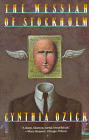
It's not easy for a book reviewer to resist a novel whose hero is a book reviewer. It is even harder when the act of reviewing a book is described in such exciting terms. "It was as if his pen, sputtering along the line of rapid letters it ignited, flung out haloes of hot grease. The air brightened, then charred. He was very quick now, he was encylopedic, he was in a crisis of inundation."
Cynthia Ozick's reviewer-hero is called Lars Andemening, a name which he has picked out of a dictionary. As the least popular of three book reviewers on a Stockholm newspaper, he specializes in the writers of Eastern Europe: Ludvik Vaculik, Bohumil Hrabel, Witold Gombrowicz, Tadeusz Konwicki. "Nobody but you wants such stuff," says the bookseller who finds him these authors. Lars is a refugee, an orphan sent from Poland as a baby, and his literary tastes reflect his roots. They also reflect his deeper secret. Lars believes himself to be the son of Bruno Schulz, who is an actual historical figure, a great writer killed by the Nazis in the streets of a remote Galician town.
Lars' belief in his secret, lost father is the keystone of his life, the thing that sets him apart and gives him his literary conscience, his abstracted personality, and a face that looks strangely young even after two failed marriages. Lars see the eye of Bruno Schulz gazing at him, or his body floating in the winter sky. Again and again, he reads Schulz's two slim books, Cinnamon Shops and Sanatorium Under the Sign of the Hourglass, then learns Polish in order to read them in the original. Lars sees his own life in Schulzian images: His bed is a bowl of dough that covers and traps him; his colleagues at the newspaper are animated waxwork figures. Lars' Stockholm is full of hints of the destruction he escaped but which Schulz did not: chimneys, and the smell of something roasting.
Heidi Eklund, the bookseller, searches out photos of Schulz, his letters, and an obscurely published story. At last she offers the most exciting and unlikely relic imaginable. A woman named Adela has appeared, who claims to be the daughter of Schulz -- and therefore Lars' own sister -- and who carries around with her the crumpled, soiled pages of what she says is Schulz's lost book The Messiah -- again, an actual work lost when Schulz was killed.
Is Adela -- the name itself comes from Schulz's stories -- really the daughter of the murdered writer? Is Lars really the son? Is the manuscript genuine, or is it a clever forgery? Ozick balances these questions in a way that is maddening but always fascinating. Her novel is an ingenious tribute to Bruno Schulz and to the joys and deceptions of literature.
Published in the Harvard Post, February 26, 1988.