


Beyond the Mountain
by Elizabeth Arthur. Graywolf Press, 211 pages, $11.00 paperback.
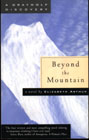
Beyond the Mountain, a novel first published ten years ago, has been reissued as a handsome paperback in the Graywolf Discovery series. It deserves this second chance at a wider audience.
A short book, Beyond the Mountain is highly concentrated but never dense or obscure. Artemis Phillips, the protagonist and narrator, is an experienced mountain climber who has joined a women's expedition to a peak (unnamed) in the Annapurna region of Nepal. The account of the expedition alternates with flashbacks to Artemis' past, and particularly to her complicated relations with her brother Orion and her husband Nicholas: her climbing partners and the two most important men in her life.
As the novel opens, both these men are dead, killed in an avalanche that had nearly killed Artemis as well. Before this disaster, when she was first invited to join the Annapurna expedition, Artemis had seen it as a means of escape. Feeling trapped in her marriage with the moody, competitive Nicholas, she had quietly decided to leave him. "I could just let the wave of my life carry me away," she had thought. "I could go to Nepal for a climb and simply never return." After the avalanche, the expedition becomes many other things for her: an attempt to forget, an opportunity to prove herself as a climber without the help of men, and a chance to reach out to others before her grief and her stubborn self-reliance seal her off from the rest of humanity.
Given such themes -- death, fear, love, trust, loyalty, fate -- and the book's setting among the Rockies and the Himalayas, the temptation to indulge in purple prose must have been enormous. For the most part, the author resists it. The novel excels in close observation, whether of the dynamics of a relationship or the techniques of scaling a rock face, and these observations are conveyed with exceptional grace and clarity. Whereas some might see the lure of mountain climbing in macho terms -- conquering the mountain, conquering oneself -- the narrator conveys the more subtle satisfactions of being in the moment, solving a series of concrete technical problems, and learning to rely on one's partner.
When we got to the base of the cliff, Nicholas stacked the rope and tied into the bottom of the stack, and what I might have seen before as a subtle test, a dare to me to prove myself, I now saw as natural politeness giving me the first lead. When I drove in a piton for the first belay, the steel rang neatly with an ever-ascending pitch, and the crack didn't bottom out but held the piton as sweetly as if it had grown there.
Though some of the members of the Annapurna expedition are elaborately introduced, then never heard from again, others become fully rounded characters who, not too obviously, mirror elements of Artemis' own personality. On one hand there is Tina, whose enthusiasm and emotional openness are immediately attractive. On the other is Naomi, tough and seemingly fearless, whom Artemis both hates and admires because she has "the kind of courage that would bring me relief from pain."
The novel has several scenes of great intensity, including more than one high-altitude rescue. But the scenes in which Artemis' relations with Tina and Naomi shift and deepen are equally absorbing, if less spine-tingling. All this takes place in an Eastern setting that is vividly present to the senses, from the smell of Bombay -- "like a mixture of cooked lamb, raw sewage, incense and rotting corpses" -- to the yak herders' huts and "purple-flowering ginkgo trees" of Nepal.
In the beauty and directness of its language, the seriousness of its concerns, and the subtlety of its psychology, Beyond the Mountain is a thoroughly satisfying novel.
Published in the Harvard Post, October 1, 1993.