


Gulf War Follies
Review of My Favorite War by Christopher John Farley
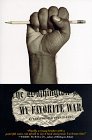
We first meet Thurgood Brinkman, the hero of this debut novel by Christopher John Farley, on the job at a "comic-book-colored" newspaper called National Now! Thurgood is 29 years old, an African American, and a graduate of Naverton College, an institution even older and more prestigious than Harvard. Stuck in his job since graduation "like one of those Paleozoic insects archeologists periodically discover trapped in amber," he finds himself writing about the accomplishments of his more successful classmates -- or assigned by his supervisor, a "serial divorcee" named Ursula Van Peemartin, to report on the craze for big vegetables and the continuing appeal of karaoke.
Thurgood's love life is equally uninspiring. Though he longs for a woman who is warm, strong, black, politically progressive, and beautiful in a natural way -- something like Joie Lee in Mo' Better Blues -- the women he actually sees turn out like Arizona Monroe, a high-tech entrepreneur whose parting gift on their first and only date (her anti-Semitic comments have put him off) is a disk containing a virus that wipes out his hard drive.
Thurgood's ideal is Sojourner Truth Zapader, an attractive black columnist for the Washington Post whose articles have the political and social punch that he wishes his own job allowed him. He pursues her in a very '90s way: by infiltrating a lesbian on-line chat room where he's been told that Sojourner hangs out. Disguised as a woman, he meets and has virtual sex with the object of his desire, only to find out, when the real Sojourner sends him an e-mail message, that he's been deceived by a fellow male cybervoyeur. Phoning her to apologize for his (attempted) deception, he leaves a stumbling message on her answering machine.
From this point on, an element of wish fulfillment helps drive the plot in improbable directions. Sojourner, having looked up some of Thurgood's press clips, is impressed enough -- though Thurgood has told us his work is heavily rewritten -- to set up a meeting. Thurgood is stunned to see his idol in the flesh; his description of her occupies three fevered pages, culminating in, "This was an Afrocentric angel. To see her in darkness was to see Reaganomics die." Yet when she offers him a job as her assistant on an assignment in the Persian Gulf, his pride doesn't allow him to accept. "Listen, I'm a seasoned reporter here," he says. "If I had any more seasoning I'd be a Cajun entrée."
A personal crisis gives him a fresh reason to go after all, and he calls Sojourner at the airport just as she is about to fly to the Gulf. As luck would have it, she is expecting him, having guessed he would change his mind. She even greets him with his own press pass, made up with a picture she has somehow obtained from his high school yearbook. Soon Thurgood is stepping off a plane into a "blast of light and heat" at a Saudi Arabian airport.
Like an all-night college bull session, My Favorite War is jumpy, colloquial, and energetic, full of ideas that are alternately perceptive and half-baked. Its hero comes across as a very young man, not only because of his taste for low humor and because he shares a house with several slovenly roommates, but because of his conspiracy-minded view of the world -- a view most common among the young, who imagine that the grown-ups are a lot smarter, more devious, and more organized than they really are.
Sojourner, too, is militant and conspiracy-minded, in such an unsubtle way that it's hard to accept her as a columnist for a leading newspaper. In Saudi Arabia she becomes even more so, showing herself on her first frontline assignment to be a tough-talking, hard-smoking war babe. "The guy knows I'm the shit," she says, lighting a cigarette after confronting a military handler. "He doesn't want any real reporters in the field."
The descriptions of wartime life in the Gulf, where an army-imposed system of "pool" reporting effectively prevents the practice of real journalism, are funny and seem authentic. It's not hard to imagine that the author, who writes for Time, may have been there. But rather than let the war stories speak for themselves, Farley turns the Gulf into a pretext for acid jokes and a stage on which Thurgood and Sojourner's social theories can be illustrated. A vivid though sketchy account of the carnage on the Highway of Death, where US warplanes bombed retreating columns of Iraqi soldiers and refugees, is followed at once by a diatribe from Sojourner, who makes an easy mental leap from the killing of Iraqis to the repression of African Americans. "Young black men are viewed as the criminal prototype in American society," she expounds as they trudge past the twisted wreckage and dead bodies. "Over one-quarter of black men in their twenties are in jail, awaiting trial, or are wanted by the police."
On she goes for a couple of pages, spouting arguments that, however true they may be, take us away from the scene we have just witnessed and any deep personal response to it. Though the war may be this novel's greatest asset in terms of material, its inclusion in an otherwise lightweight plot may also be the novel's biggest problem. You can joke about war, as soldiers do and as Joseph Heller did so brilliantly in Catch-22, but the jokes must be earned. To use the Gulf War as no more than a dramatic interlude in the life of a smart but confused young man puts a weight on this novel that all but overwhelms it.
Published in Boston Book Review.