


The Radiant Way
by Margaret Drabble. Alfred A. Knopf. 408 pages, $18.95.
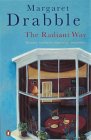
It has been seven years since the appearance of The Middle Ground, Margaret Drabble's last novel -- a long wait for her many admirers. (She has been busy, among other things, editing The Oxford Companion to English Literature.) Her book begins with a grand New Year's Eve party, as if to welcome back her readers. The party, with echoes of the balls in Tolstoy, takes place in an opulent cream-and-gold house on Harley Street in London. The conversation is clever and wide-ranging, and the presence of Anthony Keating and Kate Armstrong, characters from earlier novels, has a comforting effect. But before the party is over, a political argument ends in a bloody nose and an overturned houseplant. And as the novel picks up momentum, it becomes plain that The Radiant Way will be anything but a drawing-room entertainment.
In earlier books, particularly The Needle's Eye, Drabble chronicles the shabbiness of England in decline: the failure of businesses, the brutalization of architecture, the diminishing of expectations. In the ironically titled The Radiant Way, which deals with the first half of the 1980s, the situation is even bleaker. What is new here is the way fear and violence have come to replace resignation in English life. Avoiding, for the most part, the easy target of Margaret Thatcher and her party, Drabble describes the influences, big and small, of this ruthless decade on the lives of her characters.
For the first time in her career, Margaret Drabble is writing about a group of friends rather than a single heroine. Liz Headleand, the hostess of the New Year's Eve party, is a psychiatrist married to an electronics executive. Alix Bowen teaches English literature at a psychiatric prison where economic cutbacks threaten the progressive administration. Esther Breuer, an art historian, lives in a rundown neighborhood where the victims of an elusive murderer turn up year after year. None of the three women is as complex and quirky as Frances Wingate of The Realms of Gold or Rose Vassiliou of The Needle's Eye, but they are perhaps more plausible in their limitations, their vulnerability to the times, and their reliance on friends and family.
Having found each other as scholarship students at Cambridge, their twenty-odd years of friendship have caused them to resemble each other. "They have pooled their discoveries, have come back from outer regions with samples of leaf, twig, fruit, stone, have turned them over together. They share much. The barriers between them are, they think, quite low." As members of an intellectual elite, they have set out on what they expected would be a privileged course, a "radiant way." (The title is that of a children's primer from the 1930s, later borrowed by Charles Headleand, Liz's husband, for a documentary on the British educational system.) What they find is a world in disorder: the Falklands war, the miners' strike, the first scattered cases of AIDS.
In a time of "minimalist" fiction, Margaret Drabble is sometimes thought of as a throwback to nineteenth-century conventions. Her characters have childhoods and families, they inhabit lovingly described landscapes and interiors, and now and then Drabble will even make an authorial comment, as she does late in the book when Esther cracks a grisly joke: "And I'm sorry to say that they all laughed." Where Drabble veers away from the nineteenth century is in her tolerance of ambiguity and her willingness to let her books grow organically, with a minimum of plot mechanism. John Updike once commented that the only plot in The Realms of Gold was that an important postcard is lost in the mail and then sent on again. This is true in its way, but the real point is all the things that go on while the postcard is lying under a heap of other mail. Drabble's later novels seem to illustrate the adage that life is what happens while you are making other plans.
This looseness of construction allows Drabble to include all kinds of things in her book -- and because she is such a keen observer, these things are frequently sharp and revealing. Like Esther, the art historian, who rejects grand formulations in favor of a lizard in the corner of a painting or a particular shade of green, Drabble knows the value of a detail.
Sometimes, when accused of eccentricity or indeed perversity of vision, [Esther] would claim that all knowledge must always be omnipresent in all things, and that one could startle oneself into seeing the whole by tweaking unexpectedly at a surprised corner of the great mantle. At other times she conceded that her interests were pointless but harmless.
Some of Drabble's scenes may have nothing to do with what "plot" there is, but all contribute to the picture of an England in which desperation is no longer quiet. In a parking garage, Alix sees ominous vignettes: an executive bolting a hamburger with "starving speed and a demented, hunted expression," an illicit transaction over an open trunk, a woman smiling "obsequiously, seductively" into her rear-view mirror.
The Radiant Way is a disquieting book, especially since the reader can see that Drabble -- like most of her characters -- is essentially an optimist. We realize that the picture she presents is not as dark as it might be. Certain terrible events that threaten the characters never come to pass. Liz and Alix and Esther make their plans, and sometimes these turn out better than they themselves would ever have expected. Still, it is a world where meaningless tragedies are possible, and we care enough about the people in the book that this matters.
Published in the Harvard Post, December 4, 1987.