


The Last Station: A Novel of Tolstoy's Last Year
by Jay Parini. Henry Holt and Co. 290 pages, $22.95.
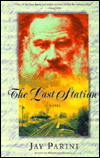
For those who know the story of Tolstoy's death at the little railway station of Astapovo, the meaning of the title The Last Station is clear. But the title has another meaning as well. By 1910, the year of his death, Tolstoy had become preoccupied, even obsessed, with moral, social, educational, and religious questions. The conflict between his monkish ideals and his comfortable existence at Yasnaya Polyana, his family estate, had become unbearable to him. His estranged, sometimes hysterical wife, Sonya, and his fanatical disciple, Vladimir Chertkov, struggled for his loyalty and affection, and for the copyright to his life's work. Like the last station of the cross, Tolstoy's death at Astapovo was the final stage of a spiritual ordeal.
Jay Parini has borrowed a technique from the great Russian novelists by making this a polyphonic novel, told in alternating voices. He has interspersed genuine passages of Tolstoy, retranslated by himself, with narrative sections based on the real-life diaries of Sonya, Chertkov, Tolstoy's secretary, Valentin Bulgakov, and several of Tolstoy's thirteen children. Parini, a well-known poet, has also included several poems on Tolstoyan themes, including a deft sestina told in Sonya's voice. Wisely, he does not put fictional words into Tolstoy's mouth. Historical figures resist being used as characters, and to create a fictional Tolstoy (apart from the Tolstoy that each of the other characters sees) would diffuse the mystery of Tolstoy's true personality and intentions, which propels the book.
By dramatizing his diary sources, Parini seeks to give them the immediacy, speed, and concentration of a modern novel. Sometimes this results in vivid prose, as when he has Bulgakov write, "Chertkov's chameleon-like skin puffed loosely about his bald, pear-shaped head. I could almost see through his forehead to the frontal lobes of his brain. He spoke stiffly, tapping his puffy fingers on the bare table." Bulgakov is given some of the best writing in the book, but there are lapses of taste. In an account of Sonya's attempt to drown herself, she is compared on a single page to a tropical fish, an otter, and a hippo. Sonya herself is made to say too many things that are banal or hackneyed. "The year has turned again, bringing us to the end of the first decade of the new century," she writes, beginning the book. "I write the strange numbers in my diary. 1910. Is it possible?" She goes on to mention her husband's snore, about which the servants say, "The old man is sawing wood." Perhaps Sonya actually wrote this, or something like it, in her real-life diary, but to include it seems unfortunate, especially since Parini elsewhere shows a sensitive understanding of Sonya's point of view.
Parini has set himself a large challenge by placing his fictionalized narratives alongside Tolstoy's genuine letters and diaries. We read fiction and nonfiction with different expectations, and when we finish reading Tolstoy's (real) letter to Gandhi and then turn to Bulgakov's (fictional) dialogue with Sonya, we are bound to be a little disappointed. The Last Station is a vivid account of life at the Tolstoy estate, but in the end it does not capture the imagination as effectively as it might have if Parini had simply organized excerpts from his sources into a nonfiction book. He seems constrained by the wish to be faithful to his sources, and because he stands between them and us, we lose not only some of the fascination of reading real letters and diaries, but the freedom of the imagination that fiction can offer.
Published in the Harvard Post, March 8, 1991.