


England in the Mire
Review of The Witch of Exmoor by Margaret Drabble
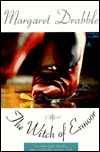
The Witch of Exmoor, Margaret Drabble's newest novel, takes place in an England marked by self-interest, hypocrisy, environmental destruction, and a general unwillingness to do anything about it. The greed and random violence that shocked the characters of Drabble's earlier novel, The Radiant Way, are now accepted elements of everyday life. Shock has given way to resignation, and questions of social justice have been turned, quite literally, into parlor games.
The first chapter of The Witch of Exmoor finds its main characters -- the two daughters and one son of the eccentric writer Frieda Haxby Palmer, and their spouses -- at a dinner party in a comfortable home in Hampshire. They are playing a game called The Veil of Ignorance, in which the goal is to imagine a society so fair that each of them might be willing to take a place in it by lottery, without knowing whether he or she would be rich or poor, black or white, gay or straight. The game is proposed by David D'Anger, the handsome and well-connected Guyanese husband of Gogo (real name Grace), who is one of the Palmer daughters. David is the only one of the group able and willing to picture a better society, but his political ambitions -- he plans to run for Parliament -- threaten to compromise his ideals.
Upstairs, Benjamin D'Anger, the son of David and Gogo, is playing another sort of game with his younger cousins. The children have been watching the violent "video nasties" collected by their Aunt Patsy, who as a member of a censorship board has a professional interest in them, but they are easily diverted when Benjamin arrives, because "none of the videos is anything like as frightening, exciting, wicked and seductive as the Power Game." The children build a city wall out of video boxes, lay out rivers, fortresses, and the figures of soldiers and captains, then wait for Benjamin to stare at the figures with his magical, hypnotic gaze, and make them move. They wait with some apprehension, "for last time there had been many wounded, many tortured, many raped, many dead."
Above and beyond these two games is the game being played by Margaret Drabble herself. The author, too, is creating a society, populating it, and posing it as a kind of moral test. As the novel gets under way, she seems to be setting the stage, parcelling out characters, and willing them into motion just as Benjamin does. The authorial comments that are one of Drabble's trademarks are thicker than ever here: she passes judgments, confesses ignorance of certain points, sometimes even asks the reader to help define a character or decide what will happen next.
The real concern of the Palmer children as they discuss society and justice is what to do about their mother Frieda, the Witch of Exmoor herself. Frieda is the latest in a long line of awful mothers in Drabble's work: willful, domineering, neglectful. A once-successful writer, she has lost her reputation after publishing a massive historical novel about Sweden's Queen Christina, a book panned by critics and ignored by readers. Frieda becomes increasingly eccentric. She abandons her silver Saab in a traffic jam, and soon thereafter buys a remote and ramshackle mansion beside the ocean in Exmoor. Before moving there, like Shakespeare's Timon of Athens she celebrates her break with a society that disgusts her by hosting an inedible feast. Instead of serving bowls of warm water, as Timon did, she offers her family hamburgers manufactured from "gristle, fat, chicken scraps, and water from cows' heads." This strange farewell over, she moves into her new home, lives alone for some months, then disappears.
More significant than the mystery of what has become of Frieda is the reaction of her family to her exile and then disappearance. Frieda embarrasses them; they have no wish to see her, but they are offended that she doesn't want to see them. Will she change her will? Will she reassign her royalties? Is she writing her memoirs, and if so, what will she say about them? David and Gogo volunteer to visit the old woman and investigate, but the others suspect them of trying to gain the inside track.
As the narrative moves on, it becomes looser, more associative, and more subtle. Freed from what had threatened to be a clockwork-mechanism plot, the characters reveal themselves not only in their attitudes and actions regarding Frieda but in more unexpected ways. Nathan Herz, for example, an advertising man first described as "short and squat and fat and hairy and balding and very ugly," is seen to be a kind of poet of commerce, a man enraptured by the beauty of perfume vials as well as of the salesgirls who sell them. Though he lacks any vision of a better society, he craves freedom and would still be willing to throw the dice and change his station in life. "Our feet are stuck in the clay," he thinks, voicing one of the major themes of the novel. "We are up to the knees, no, up to the waist, in the mud of the past. We have lived more than half our lives. There is no future. There are no choices left. It has all silted up around us. We are stuck in our own graves." The Witch of Exmoor is uneven in its tone and believability. Unsettlingly, it is the more hopeful scenes and images -- like the rescue of a hunted deer, late in the book -- that sometimes seem contrived and unconvincing. The events of this novel are no more dire than those in Drabble's other work, but the atmosphere is gloomier. The author has lost patience with her own characters, their narrowness and complacency.
Margaret Drabble is an ambitious writer, and her novels offer such a sweeping, detailed, and convincing picture of the contemporary world that it is tempting to compare her vision of our time to one's own. For a reader who has followed her work over the years, the increasing darkness of that vision registers not just as an artistic choice but as a warning.
From The Witch of Exmoor:
"Frieda walked on through the ancient woodland. It spoke to her of decay, her own decay. The trees were encrusted with lichen, and small ferns sprouted from them, as orchids sprout from the trees of a tropical rain forest. Fungus grew from living holes and dying trunks and dead logs. Grey-white oyster outcrops clustered. Ash, birch, oak and thorn, the old trees of Northern Europe. Some leant from the steep slope at perilous angles, and others were uprooted, reaching their inverted crowns into the air like great matted discs of red ogre hair, of monstrous curling fibre. Twisted faces peered at her from severed, scarred and stunted limbs. She passed the hollow tree, inside which stood a small lake on which a miniature elfin armada might sail. Scale was crazily distorted in this wracked and rent, this Rackham woodland. There was an overpowering smell of rich wet damp and decay. Stumps rose through the leafmould like old teeth. Frieda's tongue joggled her bridgework, and from beneath her loose bridge an acrid, bitter taste seeped into her mouth. It was the taste of death."
Published in Boston Book Review.