


A Little Yellow Dog
by Walter Mosley. W.W. Norton & Co., 1996. 300 pages, $23.00
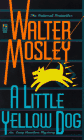
A Little Yellow Dog, the fifth in the series of color-coded, color-conscious mysteries that began with Devil in a Blue Dress, opens in 1963. Ezekiel (Easy) Rawlins, a sometime detective who has had a few run-ins with the police, is doing his best to go straight. He has a regular job as custodial supervisor at a junior high school in Watts, and he has a house in West Los Angeles where he looks after his informally adopted children Jesus and Feather.
Easy's peaceful life rests on a shaky foundation, though, and when equipment begins disappearing from the school, his past makes him an obvious target of suspicion. Then a body, "the handsomest corpse I'd ever seen," shows up on the school grounds, wearing a pair of snakeskin shoes. The dead man, it turns out, is Roman Gasteau, the brother-in-law of Idabell Turner, with whom Easy shared a steamy encounter in a deserted classroom. Idabell disappears for a while, leaving Easy with a small, yellow, evil-tempered dog.
Easy Rawlins, always a reluctant detective, realizes that uncovering the real criminals is the only way to avoid having their crimes pinned on himself. "It's no use for you to get on a bus and run," he tells Idabell. "The cops will find you. And if you run they'll prove you guilty. That's what cops do best. If they think you're guilty then making up evidence is just cuttin' corners for them. Believe me." Returning to his old haunts -- bars, gambling dens, after-hours clubs -- Easy reflects that the so-called underworld may be less tangled and secretive than what is going on at the school. "I wondered why I had ever left such a simple and honest life," he thinks (shortly before being clubbed in the back of the head).
The skills he needs to gather information while looking as innocent and ignorant as possible are, it becomes clear, just extensions of the skills he needs for everyday life as a black man in Los Angeles. "Newgate was watching me. I was used to it. White people like to keep their eyes peeled on blacks, and vice versa. We lie to each other so much that often the only hope is to see some look or gesture that betrays the truth."
Easy Rawlins' progress toward the truth is complicated by the gravitational pull of a series of black femmes fatales, of whom Idabell, who has "curves even a suit of armor couldn't hide," is only the first. There's Grace Phillips, whose lips had "never lost a thing from her African forebears." There's Hannah, "young and doe brown," and most of all there is EttaMae Harris. "She was a large woman with powerful arms and I'd been in love with her, off and on, for my entire adult life." Not all of these women can be trusted, but they are among the few sources of warmth, strength, and refuge in the treacherous world Easy moves in. Such is their power that Easy is unsurprised to learn that several white men are entangled with them too. In this world, white women hardly exist.
A Little Yellow Dog features some classic hardboiled prose. When a policeman makes an offensive comment, Easy is unfazed. "I could think of five answers; only two of them involved words." Fishing for information on Roman Gasteau, whose body is the first of several to litter the book, Easy tells Hannah that Roman owed him money. "You gonna need a shovel t' get it," she replies.
The prevailing note, though, is of melancholy. The prose sometimes takes on a bluesy feel, with the odd semicolon slowing the pace where another writer might have used a comma.
From the top of a steep stairway I could hear the weak strains of a jazz horn. Three notes and I knew who was playing. Three notes and I remembered the first night I heard that tune, the woman I was with, the clothes I was wearing (or wished I was wearing), and the rhythm of my stride. That horn spoke the language of my history; traveled me back to times that I could no longer remember clearly -- maybe even times that were older than I; traveling, in my blood, back to some forgotten home.
Crime novels generally bank on immediacy to grab the reader's interest, so it seems almost perverse when Easy reveals that he is telling a story from the past. "I was trying to live the quiet life back then," he says. But knowing this helps account for the sadness that tinges the book right up to its end, when the death of Kennedy, "the only president I ever loved," coincides with a more personal tragedy in Easy's life, so that the people standing stunned in front of stores and houses seem to be mourning both losses. "Everybody wondered would things ever get straight again; they never did."
Published in the Harvard Post, August 23, 1996.