


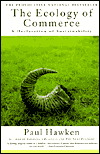
The Ecology of Commerce: A Declaration of Sustainability
by Paul Hawken. HarperBusiness, 1994. 250 pages.
Late in 2002, in a bristling letter to the editor of GreenMoney Journal, Paul Hawken attacked the magazine for accepting an ad from Chiquita, "a devastatingly unjust company that has caused untold suffering for decades."
He went on to point a blast in the direction of Domini Social Investments, writing, "In a previous issue, you featured comments and 'wisdom' from Amy Domini whose social index fund holds 357,000 shares of McDonald's. Bear in mind that in addition to the junk food McDonald's makes, it is also the largest purveyor of Coke. We won't even get into McDonald's union-busting activities, etc. So what gives? What does socially responsible investing mean anymore? Is it a way for upper middle class whites to launder their money? Do the caretakers take their job seriously? Is it simply a way to avoid the real issues?"
The Ecology of Commerce doesn't discuss socially responsible investing (SRI), but it does give offer some valuable insights into the mind of Hawken, the founder of the Smith & Hawken garden tools company and author of several books on sustainability. The book makes clear why Hawken has little patience for the kind of incremental "better owners, better neighbors" approach to the corporate world that Domini and other SRI companies follow.
Hawken believes we are in dire straits socially and environmentally, and has lots of alarming factoids to back up this claim. Corporations, he says, kill 28,000 people and injure 130,000 a year by selling dangerous and defective products. The average adult sees 21,000 commercials per year. In 1991 the ten largest businesses in the world had revenues of $801 billion, more than the smallest 100 countries. Many of our bodies are so filled with chemicals that landfills would reject them as toxic waste.
Given this situation, Hawken regards many environmental efforts with contempt. After Earth Day 1990, he says, "Onto the market flooded earth candles, 'recyclable' plastic, and millions of T-shirts with activist slogans put out by fashion companies." Corporations succeeded in shifting attention away from their own environmental behavior to that of consumers.
Some companies have taken the path of true sustainability, he says, but almost none of those he mentions are large companies, which he seems to consider beyond redemption. It's much easier for a small company to dedicate itself to sustainability than it is for a big one to change.
Sustainable businesses, says Hawken, do the following:
- Replace nationally and internationally produced items with products created locally and regionally.
- Take responsibility for the effects they have on the natural world.
- Do not require exotic sources of capital in order to develop and grow.
- Engage in production processes that are human, worthy, dignified, and intrinsically satisfying.
- Create objects of durability and long-term utility whose ultimate use or disposition will not be harmful to future generations.
- Change consumers to customers through education. (To Hawken, a customer has a complex human relationship to a company, while a consumer is a "passive instrument of commerce.")
Are any companies really this good? Hawken includes some intriguing examples. One is Natural Cotton Colours, created by an independent cotton breeder who discovered a strain of naturally brown cotton that could be crossed with traditional types of cotton to produce shades like "mint green, beige, and pale pink." The new colored cotton is grown without chemicals, and the cotton itself requires no defoliants, bleaches, or dyes.
Why don't most companies act this way? Because our economic system allows them to pass on enormous costs to the environment and society, as "externalities" - and even rewards them for doing so. If companies were forced to pay these costs, many of them would quickly become unprofitable. The state of California, for instance, calculated that if the healthcare and other social costs of smoking were borne by the tobacco companies, every pack of cigarettes would cost an extra $3.43.
Hawken's solution is simple and radical: push these externalized costs back on the companies and industries responsible for them. One way to do this is through Pigovian taxes (named for the British economist A.C. Pigou), also known as "green fees." The carbon tax, levied on the carbon content of fuels, is one of the best-known examples. The object is to force companies and industries to pay the full social and environmental cost of their operations, and so make sustainable businesses more economical.
Yes, we're talking about new taxes here. But Hawken isn't suggesting adding green fees to the existing load of income tax, corporate tax, sales tax, and property tax that we're already paying. Green fees would be phased in over a twenty-year period and would be revenue-neutral, so that other taxes would be cut by the same amount generated by the green fees. By the end of twenty years, green fees would be the only taxes we pay.
Radical? Definitely. To indicate just how radical this is, Hawken quotes approvingly from Kirkpatrick Sale: "Nothing less than a drastic overhaul of this civilization and an abandonment of its ingrained gods -- progress, growth, exploitation, technology, materialism, humanism, and power -- will do anything substantial to halt our path to environmental destruction, and it's hard to see how lifestyle solutions will have an effect on that."
Our current tax system is hard to overhaul not because it is the most efficient or most just system we could think of, but because it represents a mass of loopholes, special incentives, and political compromises. It is hard to see the political obstacles to creating a system of green fees could be overcome, but Hawken presents a lot of intriguing detail on what might happen if they were.
"Of all the possible green fees," Hawken writes, "taxing energy would be the most fruitful and beneficial." Companies like ExxonMobil would face higher costs, but once green fees have made conserving cheaper than drilling, hundreds of mom-and-pop companies could spring up to offer weatherproofing, photovoltaic systems, and double-glazed windows. Energy taxes would also help cut down on rush-hour traffic jams and benefit organic farmers over those that make heavy use of fossil fuels.
Many companies and even some industries might disappear if this were done, but he argues that big, rapacious corporations would give way to many more small, local, and sustainable businesses. It may be a utopian vision but it's an attractive one.