


Faith and Fortune: The Quiet Revolution to Reform American Business
by Marc Gunther. Crown Business, 2004. 289 pages.
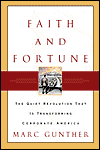
"Despite most of what you've read about business lately, corporate America is changing for the better," writes Marc Gunther at the beginning of Faith and Fortune. "This is a book about the people who are leading the way, and the companies where they work."
Whether or not you agree with this rosy assessment (and it comes not from a starry-eyed idealist but from a senior editor at Fortune magazine) the company profiles in this book are worth reading -- not least because they include entire chapters on Amy Domini and on eight of the companies in the Domini 400 Social Index: Southwest Airlines, UPS, Starbucks, Timberland, Herman Miller, Hewlett-Packard, Staples, and PepsiCo.
"Who cares about Pepsi?" I hear you saying. "What does he say about us?"
Gunther concentrates more on Amy's career in SRI than on Domini Social Investments as a company. Though the outlines of her career will be familiar, Gunther presents it gracefully, with details I hadn't seen before and quotations that bring it to life.
"People were losing money," Amy says of her start in finance in 1973, "and I saw all these guys who looked like they were very important men helping them to lose their money, and I thought, 'I could do that, too.'"
When Amy's brokerage company recommends a military stock to sell, Amy has her road-to-Damascus moment:
"And suddenly I thought, 'Amy, how far have you fallen?'" she said, recalling the moment many years later. "How far had I fallen that I might consider calling people I was fond of and urging them to make an investment in a killing machine, a company that had essentially bought its way, or bribed its way, into a contract?" She did not -- she could not -- make the calls.
Gunther has a good understanding of the nuances of SRI (though he does refer to the "Domini Social Index Fund"). He acknowledges that SRI is older than Amy, but credits her with bringing the industry into the mainstream. He outlines the change in Amy's thinking from an emphasis on screening to a more activist approach, and to breaking down the barriers preventing the growth of SRI. He covers KLD and the creation of the Domini 400, and devotes about two pages to the controversy over McDonald's, with excerpts from Amy's debate with Paul Hawken in GreenMoney Journal.
Gunther also provides interesting details on the other companies he profiles. Here are some nuggets:
- Southwest Airlines weathered 9/11 better than most airlines in part because its reservation agents, flight attendants, pilots, and other staff are "trained to help customers first and ask questions later." The airline also had the "lowest costs, the strongest balance sheet and the highest credit rating in the U.S. airline industry." While the rest of the industry laid off about 20% of its workforce, Southwest laid off no one.
- Unlike Southwest, UPS runs a highly automatic, highly routine operation where employees have to follow many specific rules. Yet UPS achieves a high degree of employee loyalty. Few companies, says Gunther, "reward, engage and motivate their people better than UPS."
- Although Starbucks has resisted buying much Fair Trade coffee, Gunther points out that only coffee grown by worker-owned cooperatives qualifies for the Fair Trade label, and that in 2000 Starbucks paid an average price of $1.20 per pound for the coffee it did buy: close to the $1.26 per pound required for Fair Trade certification. Starbucks has its own guidelines under which it pays more to farmers "who meet a long list of social, environmental, economic and quality standards."
The author provides some intriguing examples of how some companies have been shaped by the religious or spiritual beliefs of their leaders.
- Tom Chappell, the founder of Tom's of Maine, is a former Episcopal minister whose company "treats its customers with respect," "tries to minimize its environmental footprint," and gives 10% of its pretax profits to charity.
- Bernard Glassman, the founder of Greyston Bakery of Yonkers, is a Zen Buddhist priest whose business is owned by nonprofit foundation that helps "provide apartments for the homeless, care for people with HIV/AIDS," and "furnish job training, child care and a community garden."
- Herman Miller was founded by a family of "churchgoers and devout men" who insisted that "each individual is unique, special and deserving of respect." The company continues to draw on these beliefs in shaping its approach to designing workspaces, treating its employees, and respecting the environment.
Overall, however, the treatment of spirituality is a little skimpy. Though it offers a lively account of a number of remarkable companies, Faith and Fortune does not quite deliver on the promise of its title.