


Faithful Finances 101: From the Poverty of Fear and Greed to the Riches of Spiritual Investing
by Gary Moore. Templeton Foundation Press, 2003. 228 pages.
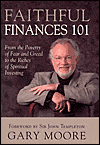
At first glance Faithful Finances 101 would seem to be the book to consult to find out how religious-based mutual funds like MMA Praxis, the Noah Fund, and the Timothy Fund practice socially responsible investing, and how this differs from the "social" or "environmental" approach used by Domini, Calvert, Parnassus, and other mainstream SRI funds.
The first glance would be wrong, however. Except for positive references to the community development work of ShoreBank (called here by its older name, South Shore Bank) and to the investment philosophy of Sir John Templeton, there is very little in this book about the nuts and bolts of investing according to religious (specifically Judeo-Christian) principles.
This is unfortunate, since Moore has some unorthodox ideas on the subject. He questions, for instance, whether SRI funds should be so heavily invested in technology, quoting maverick physicist Freeman Dyson's criticism of high-tech companies for making "toys for the rich" like cell phones and laptop computers at a time when two-thirds of the world's homes don't have telephones. Moore himself is on the board of Opportunity International, which makes $200 microloans to entrepreneurs in developing countries.
Moore is a long-time student and admirer of the legendary investor Sir John Templeton, and refers often to Templeton's saintly personality, his philanthropic work, and the ethical principles that caused him to exclude alcohol, tobacco, and gambling stocks from his mutual funds. (It appears after some digging that the Templeton funds -- sold by Sir John to the Franklin Group in 1992 -- may be "stealth SRI." According to Templeton's CIO, the funds continue to screen out "sin stocks," but this is not stated in their prospectus or anywhere else. As a result, the Social Investment Forum and others don't list them as SRI funds.)
Faithful Finances 101 is concerned more with principle than with practice. The book will be valuable primarily to those who are struggling to reconcile their Christian beliefs with the way they use their money, and to anyone trying to interest thoughtful Christians in SRI.
If any group of people emerges as the "enemy" in this book, it is the evangelical Christians who in his view have whipped up irrational fear over issues such as Y2K and the Gulf War and national debt of the '90s (not the current Gulf War and national debt, which he does not mention). Though fear helps the evangelists raise money for their own organizations, Moore argues that it kills most charitable giving and undermines the optimism needed for successful investing. Fearing the end of the world, he notes, fearful people bought generators in preparation for Y2K only to have them gather dust afterwards -- while people in developing countries could have used them to meet their real needs.
Moore is also critical of the "Disneyland" version of faith expressed in books like The Prayer of Jabez, an example of the "prosperity gospel" that promises great material reward in return for faith. Prosperity should not be the goal of religion, though it may be a welcome byproduct. "If I had to cite one concept that summarizes the economic approach of the Bible, it would be the paradoxical statement to: 'Seek first the kingdom and all this shall be added unto you.'"
Most of this book consists of Moore's interpretation of biblical passages as they relate to our use and abuse of money. Moore finds in the Bible a message of patience, hope, and a belief in abundance rather than scarcity. In terms of its attitude toward money, he says, the Old Testament primarily counsels us "to become prudent and ethical co-creators of wealth for ourselves, our neighbors, and particularly for those in need." The New Testament counsels us to "avoid anxiety over the economic future and subsequently to avoid preoccupation with material well-being."
Moore's readings of the Bible are strikingly humane. Though the Bible is known for attacking "usury," other passages present lending as a positive good ("when someone wants to borrow something, lend it to him," Matthew 5:42) and advocate the forgiving of loans every seventh or fiftieth year. Moore himself is sympathetic to the forgiving of Third World debt. Against hard admonitions such as "sell all you have and give the money to the poor" he counterposes the apostle Paul's recommendation of "moderation in all things," and examples of rich men in the Bible who were nonetheless considered godly. (That Moore is personally well off we can deduce from his comment that in America, "most of us have two homes, two cars, two televisions, and two or more of lots of other things.")
Some of the passages Moore interprets seem predigested, thanks to his reliance on a modern translation of the Bible (apparently the Good News Bible) that attempts to interpret rather than translate the rich metaphorical language of the original Hebrew and Greek. "Invest your money in foreign trade," says Ecclesiastes 11:1 in this version, "and one of these days you will make a profit." If this seems unfamiliar, the King James Version may ring a bell: "Cast thy bread upon the waters: for thou shalt find it after many days." This a verse that can surely be read in more ways than one.
Faithful Finances 101, writes Moore, is not about how to manage wealth but about "how to love God and neighbor as self." The paradox, he says, "is that this is the best wealth management strategy I've learned in twenty-five years on the street."