


Confessions of an Economic Hit Man
by John Perkins. Berrett Koehler, 2001. 230 pages.
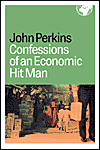
As Lily Tomlin once said, "No matter how cynical I get, it's hard to keep up." Confessions of an Economic Hit Man illustrates this concept perfectly.
Even if you already believe that large-scale international aid is a disaster, even if you've read exposés like The Road to Hell and Lords of Poverty, this book may still shock you. The author makes his main points on the first page:
Economic hit men (EHMs) are highly paid professionals who cheat countries around the globe out of trillions of dollars. They funnel money from the World Bank, the U.S. Agency for International Development (USAID), and other foreign "aid" organizations into the coffers of huge corporations and the pockets of a few wealthy families who control the planet's natural resources. Their tools include fraudulent financial reports, rigged elections, payoffs, extortion, sex, and murder. They play a game as old as empire, but one that has taken on new and terrifying dimensions during this time of globalization.
I should know; I was an EHM.
It's no secret that aid from the World Bank, IMF, and USAID often leaves a developing country worse off than it was before. It's no secret that "aid" is often a way for pharmaceutical companies to dump expired medicines and get a tax deduction, or for well-connected U.S. companies to get paid for building unnecessary prestige projects like enormous stadiums and conference centers. Millions of dollars never actually leaves the U.S. Millions more are siphoned off by corrupt dictators like the late President Mobutu of Zaire, and once these dictators die or are deposed, their people are held accountable for the debt.
Yet if the international donors are so adept at lining their pockets, why is it that they make loans that should know can never be repaid? Are they that sloppy? Or does it happen because officials are rewarded for lending money, not for finding problems?
Perkins provides the simple answer: Loans are made because the lenders know they can never be repaid. Unpaid loans give the lender permanent leverage over the developing country that has been plunged into debt. Like the Mafia, Perkins says, "we demand our pound of flesh. This often includes one or more of the following: control over United Nations votes, the installation of military bases, or access to precious resources such as oil or the Panama Canal. Of course, the debtor still owes us the money -- and another country is added to our global empire."
As an economic hit man, Perkins worked not for the U.S. government or World Bank but, more discreetly, for a private consulting company called MAIN. In countries like Indonesia, Ecuador, and Columbia he produced wildly inflated projections for economic growth to justify massive loans.
In Saudi Arabia the challenge was different: making friends with the Saudi royal family so that MAIN's client companies could absorb as much of the country's new oil money as possible. Perkins realized fairly early that (as U.S. News & World Report wrote in 2003) Saudi Arabia had become the "epicenter" of terrorist financing and that "Saudi largess encouraged U.S. officials to look the other way."
What happened when a country wouldn't cooperate? In Panama, Perkins cut a deal with General Torrijos, the country's leader, who knew how the game was played. "I understand that your company wants more work and usually gets it by inflating the size of projects," says the general. "This time is different, though. Give me what's best for my people, and I'll give you all the work you want."
Perkins agreed, but as time passed Torrijos proved too resistant to U.S. interests. Perkins believes that Torrijos' death in a plane crash in 1981 was the work of the "jackals" of the CIA, and that the earlier death of Ecuador's president, which bore "all the markings of a CIA-orchestrated assassination," had been intended to send Torrijos a message.
Even assassination is not the final limit for those who serve what Perkins calls the "corporatocracy." In Iraq, he writes, the EHMs have failed, the "jackals" have failed, and so "young men and women were sent to kill and die among the desert sands." He finishes his book with some intriguing speculations about what might happen next. With the U.S. in control of Iraqi oil supplies, the close relationship between the U.S. and Saudi Arabia might be less necessary. OPEC might reassert itself, with the possibility of undermining the American empire. Simply by replacing the dollar with the euro as its standard currency, Perkins argues, OPEC could "shake the empire to its very foundations."
Despite a certain amount of self-dramatization, Perkins has written an eye-opening book that sheds a harsh light on economic forecasts, the international aid business, and lending policies that might otherwise seem senseless.