


How to Change the World: Social Entrepreneurs and the Power of New Ideas
by David Bornstein. Oxford, 2004. 320 pages.
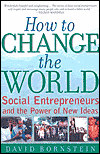
At the 2004 SRI in the Rockies conference, David Bornstein spoke about social entrepreneurs: individuals who create and implement breakthrough innovations that can change the world.
Bornstein, whose first book was about the pioneering work of the Grameen Bank in providing microloans for the poor, traveled extensively for several years to research the impact of social entrepreneurs. These are a few of those who are profiled in his new book:
- Jeroo Billimoria, an Indian social worker who studied in the U.S., created a telephone hotline to help street children in Bombay. Childline is mostly run by street children themselves, who answer the phones, respond to calls, and market the service. The service, which began in 1996, was operating in 30 cities by 2002. Billimoria is exploring ways to coordinate similar efforts in countries including the U.K., Philippines, Zimbabwe, and Pakistan.
- Fábio Rosa transformed the lives of rural Brazilians by inventing low-cost methods to electrify farms and pump groundwater for irrigation. To overcome the prohibitive cost of installing small-scale solar systems, he devised a way to use them to power electric cattle fences at a much lower cost than conventional methods.
- J.B. Schramm invented a four-day "College Summit" program that enables low-income high school students with middling test scores to identify their strengths, describe them effectively in essays, and prepare customizable college applications -- greatly increasing their chance of being accepted to college.
- Harley Henriques do Nacimento addresses AIDS in northeastern Brazil by dealing with social problems and attitudes. "Now, when we go into a community, we don't mention AIDS for six months. We have learned that people first have to gain knowledge about their bodies and living conditions. So we begin by talking about what it means to be black in our society. We talk about gender. We build up commitment and confidence."
Most of the social entrepreneurs discussed in How to Change the World were identified and supported by Ashoka, a nonprofit organization founded in 1980. Ashoka functions as a kind of venture capitalist, providing money and support to people like these once they have demonstrated their ideas on a small scale and are ready to ramp them up to a larger scale.
Social entrepreneurs, according to Ashoka and Bornstein, are born, not made. Their drive to change the world typically dates to childhood. Ashoka has a complex and demanding process for identifying them, but research indicates they have these things in common:
- Willingness to self-correct
- Willingness to share credit
- Willingness to break free of established structures
- Willingness to cross disciplinary boundaries
- Willingness to work quietly
- Strong ethical impetus
According to Ashoka's website, "Social entrepreneurs are not content just to give a fish or teach how to fish. They will not rest until they have revolutionized the fishing industry." How to Change the World is an inspiring look at how much people like this can accomplish.