


Fat Land: How Americans Became the Fattest People in the World
by Greg Critser. Houghton Mifflin, 2003. 232 pages.
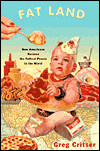
"Today Americans are the fattest people on the face of the earth (save for the inhabitants of a few South Seas islands)," writes Greg Critser in Fat Land. "About 61 percent of Americans are overweight -- overweight enough to begin experiencing health problems as a direct result of that weight. About 20 percent of us are obese -- so fat that our lives will likely be cut short by excess fat."
Alarmingly, many of these fat Americans weren't fat a few years ago. The percentage of overweight people, constant at 25% for many years, began to increase dramatically around the late 1980s. The result has been a massive increase in weight-related diseases such as coronary heart disease, hypertension, gall bladder disease, stroke, and more. Type 2 or adult-onset diabetes now afflicts large numbers of children, and Critser provides an unnervingly detailed description of its effects, from gallstones to numb limbs to blindness.
How did this happen? Critser spends much of the book outlining the reasons. Beginning with some obvious truths -- we eat too much fast food, we watch too much TV, and we don't get enough exercise -- he digs deeper to see why that is, and why the situation is so much worse than it was a generation ago.
Critser states plainly that poverty, class, and income are highly correlated with obesity. Though a more in-depth discussion would be welcome, he does float some interesting hypotheses as to why this is. Poor people, not feeling secure about where their next meal is coming from, may be tempted to "eat for today." Parents who live in unsafe neighborhoods will keep their children inside watching TV rather than outside playing. And for many people food may be a way of assuaging the "pain of poverty." As one doctor says, "It's tiresome being poor. Living in the cocoon of obesity is a very comfortable thing to do."
Willpower and personal choice are important factors in the fat problem, Critser believes. Parents, the schools, the churches, and society in general, he says, have failed to define and enforce limits on overeating and unhealthy eating. "Me Generation" parents bought the myths that children will eventually eat what's good for them if left to choose on their own, and that criticizing their eating habits will give them complexes or drive them to anorexia. These parents, scarred by painful memories of gym class, have been willing to vote for tax cuts that meant the elimination of phys ed from schools (along with art, music, and other frills).
The schools, their budgets slashed by these same tax cuts, have cut lucrative deals with McDonald's, Coca-Cola, and Pizza Hut to supplement or even replace traditional school lunches with fast food. Religious leaders, unwilling to drive away churchgoers, have concentrated on sins other than the widespread sin of gluttony. Ordinary people have been eager to believe that low-fat or low-carb diets will solve their weight problems, and the news media have seized on studies that seemed to indicate that a little housework or a casual stroll might be all the exercise you need.
For socially responsible investors, the most relevant parts of Fat Land are those that describe the practices of the fast food companies. In addition to the way they push burgers and pizza through the schools, Critser points out several ways in which these companies are part of the problem.
One factor is what goes into the food. High-fructose corn syrup, developed in Japan in 1971, is cheap to produce and keeps foods looking and tasting fresh longer. Today it is the main ingredient of most soft drinks. But high-fructose corn syrup isn't broken down by the body as normal sugars are. It arrives at the liver almost intact, to be converted easily into fat. Palm oil is another relatively recent addition. Once used by McDonald's to make its french fries, palm oil contains a higher level of saturated fat than hog lard.
The term "supersizing" may make us think of McDonald's, but the concept was used earlier by Burger King, Wendy's, Pizza Hut, and Domino's. Fast food marketers discovered that a customer who thought it was piggish to order two bags of fries would happily get one enormous bag, especially when it was bundled with a burger and soft drink at a low price. Since the profit margin is much higher on fries and drinks than on burgers, this kind of upsizing and bundling was a money-making machine. Meanwhile the calorie count of a typical McDonald's meal went from 590 to 1,550.
Since McDonald's invented the Happy Meal in the mid-'70s, fast food has been aggressively marketed to children. By 1993, the author says, "41 percent of all Saturday morning kid show ads were for high-fat foods. What was once a time for children to get a few laughs on a non-school day had become a time to indoctrinate them on the benefits of grease, salt, and ever increasing amounts of sugar."
Critser's last chapter, "What Can Be Done," is noticeably weaker than the rest of the book. He presents a few examples of successful diet-and-exercise programs, but has few ideas about how the fast food companies might change their practices. They could resize their portions, he says, noting that snack makers already have small-size lines for the European market -- but why would they, when the larger sizes are so profitable and popular?
Are the products of a company like McDonald's so destructive to the health of society that socially responsible investors should have no part of them? Or should we take the position that a Big Mac, eaten as an occasional treat, may be part of a generally healthy lifestyle, and simply try to influence companies to, for instance, place limits on advertising to children, offer healthier food alternatives, and reduce their use of saturated fats and trans-fatty acids? Thes are questions that many people in the socially responsible investment community will have to grapple with.