


The Queen's Throat: Opera, Homosexuality, and the Mystery of Desire
by Wayne Koestenbaum. Vintage Books, 1994. 271 pages, $12.00 paperback
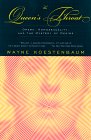
You don't have to be gay, or an opera buff, to appreciate this book about homosexuality and opera. It's enough to have a taste for verbal ingenuity, breathtaking candor, and sly wit, and to be interested in questions of secrecy, loneliness, coded messages, and sexual identity.
If you've been to Jonathan Demme's film Philadelphia, or watched the clips shown on Academy Awards night, you've seen Tom Hanks, at the high point of his Oscar-winning performance as a gay lawyer with AIDS, listening to an aria on the stereo and trying desperately to explain what it means to him. The music and the voice speak of passion and mortality with an urgency that seems to have no place in everyday life.
What is it about gay men and opera? (Though Koestenbaum devotes some attention to lesbians and opera, it is when writing about gay men such as himself that he catches fire.) To answer that question, the author puts forward many startling propositions. "Opera has always suited those who have failed at love," he says, and "Opera has the power to warn you that you have wasted your life." Some of these propositions are funny: "I think Baltimore is America's queeniest city because John Waters called it the Hairdo Capital of the World, because in Baltimore I began to go crazy over divas, and because Baltimore is near Rosa Ponselle's Villa Pace." Others would be funny if they were not so grim: "Home is the boot camp for gender; at home, we are supposed to learn how to be straight."
"I'm a neat, fussy homosexual," the author says, "you know the type." Rather than simply rejecting stereotypes of the gay man and the opera queen, Koestenbaum unfolds them to show that they are much more complex and interesting than they seemed at first.
A love for opera, particularly on record, is a nostalgic emotion, and gay people are imagined to be a uniquely and tragically nostalgic population -- regressive, committed to dust and souvenirs. A record, a memento, a trace of an absence, suits the quintessentially gay soul, whose tastes are retro and whose sexuality demands a ceaseless work of recollection: because queers do not usually have queer parents, queers must invent precedent and origin for their taste, and they are encouraged, by psychoanalytic models, to imagine homosexuality as a matter of trauma and adaptation.
The reference to psychoanalysis is not merely academic base-covering (the author is not only a published poet and an opera queen but a professor of English at Yale). Koestenbaum knows his Freud: not just the usual well-worn concepts of "Freudian slips," the Oedipus complex, and so on, but the intriguing associations between fussiness, hoarding, and artistic production that Freud examined in the essay "Character and Anal Erotism." The parallels he draws between record care and sexual hygiene, between sound reproduction and sexual reproduction, are intriguing and hilarious. "At one time I wanted to be sexually stereo. Now I'm happy with my mono life.... Remember quadraphonic? Remember orgies?"
Now and then, the thrill of speculation takes the author a little too far.
Because sound emerges from the singer's mouth, and because singers' bodies are mythically unsightly, it makes sales-sense, and it saves space, to shield the body and present only the singer's head in opera record ads. But another meaning emerges: decapitation. Do we interpret this decapitation as castration, and connect it to the imagery and reality of castration that is opera's heritage, and that is one source of opera's folkloric association with emasculation?
Well, no -- I'd say we don't. But such overreaching only occasionally detracts from the pleasures of the book. See the wonderful list of types of opera queen to watch out for, on pages 34 and 35, including "the opera queen who doesn't recognize himself in this description." See the "Pocket Guide to Queer Moments in Opera" that ends the book. See Regretful Codas #1 and #2. Enjoy.
Published in the Harvard Post, May 13, 1994.