


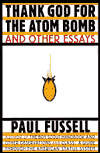
Thank God for the Atom Bomb
by Paul Fussell. Summit Books (Simon & Schuster). 298 pages, $17.95.
One of the best essays in Paul Fussell's lively new collection is "George Orwell: The Critic as Honest Man." When Fussell defines a critic, and Orwell in particular, as "an essayist obsessed with values," we begin to suspect that Fussell is thinking of himself. This becomes even clearer when he lists what Orwell believed were the critic's responsibilities. Here are only two.
The critic should read everything all the time -- labels, signs, pamphlets, corporate reports, college catalogs, poems, novels, plays, "non-fiction," press releases -- the lot. His business is language and its behavior in relation to human beings and their desires. The critic should beware generic snobbery -- literature has its social classes just like life.He should be interested in everything: the love life of toads, the way tortoises drink and the poor die, the dynamics of anti-Semitism, the differences between Caslon and sans-serif types, the motives impelling ordinary people to read, why books get written at all, the price of food, the reason women do not as a rule become stamp collectors, and the reason shipwrecks and trial scenes are literary staples.
Fussell follows the first rule when, for instance, he begins his first piece by quoting (and praising) an ad for Teacher's Scotch. He follows the second by writing about nudism in the Balkans, the Indianapolis 500, and the history of a World War II memoir forged for propaganda purposes.
Fussell's willingness to step on toes, which is equal to Orwell's, is bracing and sometimes even startling. Not only does Fussell condemn censorship of the student newspaper at the University of Pennsylvania (where he teaches), but he reprints photos of a fellow professor making off with a bundle of the Alumni Day issue, its lead story headed "Wharton Prof Charged with Raping Child." Not only does he criticize authors who complain about the reviews they receive, but he singles out May Sarton (rather cruelly) as an extreme example.
His attacks are often creative. In a broadside against the National Rifle Association, Fussell does not suggest that the right to bear arms be revoked, but instead that the Second Amendment clause about a "well-regulated militia" be taken seriously, and that all those wishing to own guns be required to do eight hours of drill each Saturday, dig foxholes and latrines, eat beans and fatty pork, and carry out paramilitary duties such as "patrolling angry or incinerated cities."
The title essay is the one most likely to raise hackles, and for good reason. Here Fussell attempts to explain (if not exactly justify) the bombing of Hiroshima and Nagasaki, on the grounds that an invasion of the Japanese home islands, scheduled for November 1945, would have cost a million US casualties and many more Japanese. Fussell himself was to have taken part in the invasion, and he makes much of the fact that many critics of the bombing are too young to have faced any danger at that time beyond falling out of a pram or off a bicycle. He outlines what a full-scale invasion would have meant, with examples of the atrocities committed by both sides in hand-to-hand fighting in the Pacific.
Some of these issues emerge in an "exchange of views" between Fussell and Michael Walzer, the author of Just and Unjust Wars, which Fussell, to his credit, includes in the book. Walzer reads "Thank God for the Atom Bomb" as a justification of the bombing (as it is hard not to do) and makes mincemeat of it, arguing that the massacre of civilians in order to save soldiers may be expedient but is certainly not moral. It is, in fact, an act of terrorism. Walzer also raises the question of whether an invasion was necessary at all, or whether some flexibility in the US demand for unconditional surrender might not have ended the war through negotiations.
Fussell would say that for himself in 1945, this was not an issue. An invasion might have been a big mistake, but he could see that it was going to happen. In his response to Walzer, Fussell argues that the intent of his essay was to recreate the suffering and complexities of 1945 and to "complicate, even mess up, the moral picture." "I was saying that I was simultaneously horrified by the bombing of Hiroshima and forever happy because the event saved my life." We should read the essay with this in mind: critically, warily, and more for its picture of a soldier's thinking than for its dangerous and contradictory moral conclusions.
Published in the Harvard Post, September 2, 1988.