


Thy Hand, Great Anarch! India 1921-1952
by Nirad C. Chaudhuri. Addison-Wesley. 979 pages, $29.95.
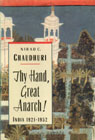
Thy Hand, Great Anarch! is a great book, and like many great books it stubbornly resists classification. Is it an autobiography? A memoir? A history? Yes -- and no. It is too all-inclusive to be an autobiography, too intellectually ambitious to be a mere memoir, but at the same time much too personal, too highly flavored, too idiosyncratic to be a history in any usual sense. In a way it is an anthology, because it includes among other things a short story on the subject of cremation and an excellent critical essay on the life and work of Rabindranath Tagore. But the categories that come a little closer to the mark have the same antique quality as the lines from Pope that provide the book's title. Thy Hand, Great Anarch! is a tragedy, a lament, even a kind of mock epic featuring a hero, the author, who in his own words is scraggy, pinched, indolent, obstinate, and proud -- at the age of 91 a "striking instance of the survival of the unfittest."
In The Autobiography of an Unknown Indian, published over 35 years ago (and soon to be reprinted as a companion volume to Thy Hand), Chaudhuri described an idyllic childhood in a region of Bengal that is now part of Bangladesh. The beauty of the watery landscape and the vitality of Bengali culture are vividly rendered, and to read this volume first adds to the poignance of the story Chaudhuri tells in Thy Hand. Bengal, in Chaudhuri's view, had been the traditional source of India's cultural, intellectual, and political leadership. But the creativity and impulsiveness of the Bengalis eventually led to political intrigues and an ill-considered terrorist campaign against the British that lost them their leading position in the Indian National Congress and hence in modern India. The field was left to Gandhi and his followers, with what Chaudhuri considers disastrous results.
Chaudhuri's highly critical view of Gandhi is likely to be the most startling feature of this book for American readers. He speaks of Gandhi's "insatiable love of power" and of his "simplicity of character, which made him more tortuous than the worst crook."
"The worship of Gandhi," he says, "is in the British above all, unqualified imbecility and a sure proof of the degeneration of the British character." Yet Chaudhuri was at one time of his life a follower of Gandhi, and found both his beliefs and his personality very impressive. The expression on Gandhi's face "was one of extraordinary innocence and benignity, with two soft beams streaming out of his eyes.... There was not a trace on his face of the repulsive arrogance which disfigures the face of every Hindu holy man." Chaudhuri believes that Gandhi was sincere in his devotion to peaceful resistance, but that he failed to recognize that by appealing to the primitive nationalism of the masses he was negating all that the British Empire had done to unify and civilize India, and was setting the stage for the bloody Hindu-Muslim riots that followed independence in 1948 -- and for the ultimate partition of the country.
Gandhi, of course, does not bear all the blame for this. A hefty share remains for the British themselves, for having cut and run with too little concern for what would happen next. Chaudhuri's feelings for Britain are deep, and deeply divided. On the one hand, he has the greatest love and respect for English literature, law, and fair play, and for the Empire itself, which in the notorious dedication to Unknown Indian he honored for having "made, shaped, and quickened ... all that was good and living in us." On the other hand, he remembers with resentment and contempt the boorish civil servants who represented Britain in India, and their scorn for "clever Babus" such as himself. He blames the British for not being imperialistic enough -- that is, for ceasing to take their imperial mission seriously and failing to instill basic Western institutions in a country that badly needed them. Chaudhuri's position is here diametrically opposed to Gandhi's. A reporter is said to have asked Gandhi what he thought of Western civilization, to which he replied, "I think it would be a good idea." Chaudhuri, for his part, believes passionately in Western civilization, and is outraged by the failure of decadent Westerners to uphold it.
Thy Hand, Great Anarch! is remarkable for its unity of tone, whether Chaudhuri is describing the long-ago arrogance of a British policeman who ordered him off the sidewalk, or the political schemes that led to Partition. One reason for this is that he regards events both large and small as things that have happened to him. As a politician's secretary, a broadcaster for All India Radio, or a writer on military topics, he takes everything personally. Everything provokes a moral as well as an emotional response. He takes pride in having been right about certain aspects of British policy, or about the Indian attitude to World War II, even though his opinions were never likely to affect the course of history.
"Who is this Nirad C. Chaudhuri who considers his opinions so important?" we may ask ourselves, but it is probably the wrong question. All history is written from one point of view or another: there is no such thing as an "objective" history. Where Chaudhuri distinguishes himself is in the frankness with which he expresses his idiosyncratic views, and in the force and accuracy of his writing. When a book has a voice this distinctive, it becomes a work of literature. Whether Chaudhuri is "right" when he decries popular music, Western preoccupation with the Third World, or the "abandonment" of the whites in Rhodesia will ultimately be less important than that he has succeeded in weaving his life together with the life of modern India. As a critic once said of Proust, Chaudhuri has put everything he knows into this book -- "a mistake made only by amateur writers and very great ones."
Published in the Harvard Post, December 16, 1988.