


Who Got Einstein's Office?
by Ed Regis. Addison Wesley. 316 pages, $17.95.
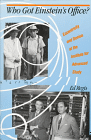
Ed Regis's new book, subtitled "Eccentricity and Genius at the Institute for Advanced Study," is an account of one of the world's oddest institutions. The Institute for Advanced Study has an administration, postdoctoral students, and a legendary faculty, yet it offers no courses, grants no degrees, and maintains no laboratories. It lies near Princeton University but has little connection with it, or with the real world. As Regis half-mockingly terms it, it is the Paradise for Scholars or the Platonic Heaven, a retreat for theorists who want no responsibilities or distractions to keep them from the pursuit of abstract thought and ideal forms. It owes its existence to the Bamberger department-store fortune, though what the Bambergers themselves had really wanted was a medical school in Newark.
Regis does not attempt to write a complete history of the institute. (Such a history was written in the 1950s, in two volumes, and promptly suppressed.) Leaving aside the social science and history faculties, he concentrates on the institute's physicists and mathematicians, beginning with Albert Einstein, still the patron saint of the place. (Mail for Einstein still arrives there.) In so doing, he mixes entertaining anecdotes with a number of lucid explanations of some of this century's most abstruse scientific problems. Among the anecdotes are one about how Kurt Godel nearly failed his test for United States citizenship by pointing out inconsistencies in the Constitution, and another about P.A.M. Dirac's reaction to Crime and Punishment. "It is nice," said Dirac. "But in one of the chapters the author made a mistake. He describes the sun as rising twice on the same day."
The explanations of scientific problems cover fractals, cellular automata, "superstrings," the discovery that galaxies occur on the surface of enormous "bubbles" in space, and the reasons why the universe does not collapse on itself. Occasionally, when a topic cannot be simplified enough for the general reader, Regis will simply mention its significance, as with Godel's discovery of "incompleteness" in mathematics. Sometimes, too, he invites us just to enjoy the incomprehensibility of something like Tim Morris's lecture on "Instantons and the Super Yang-Mills Beta Function." (After hearing this lecture, Regis meets Freeman Dyson, currently the star of the Institute. "How did you like our little seminar?" asks Dyson. "It was Greek to me," Regis admits. "Then you understood as much of it as I did," says Dyson.)
There is also a fascinating and extended discussion of the gap between, on the one hand, philosophers of science like Thomas Kuhn who see scientific "discoveries" as entirely relative, conditioned by the assumptions of the society in which the scientist works, and on the other hand, the scientists themselves who for the most part believe they are approaching the objective truth about the universe, especially now that superstrings promise to reconcile all previous theories of the universe into a great overarching Theory of Everything.
Who Got Einstein's Office? is by no means a puff piece for the institute. Apart from the bickering and faculty revolts that have occurred there as at any academic institution, the institute's history has been marked by doubts as to whether it is really a good thing for a scientist to have nothing to do but think. J Robert Oppenheimer, Wolfgang Pauli, Julian Schwinger, and Richard Feynman all turned down professorships there, though Pauli later changed his mind and Oppenheimer eventually became the institute's director. Einstein spent twenty years there, but without succeeding in his aim of creating a unified-field theory. With few exceptions, a scientist makes no major discoveries after becoming a professor at the institute. Whether this is the institute's fault, or simply means that professorships are offered only after a scientist has done what is probably his best work, is an open question. But for younger, temporary appointees, the institute still provides a haven where a scientist can work toward a breakthrough without the pressures of making a living or teaching classes.
Regis presents a great deal of history and science very painlessly, but at the cost of sometimes lapsing into an overly chatty style. Referring to Heisenberg's uncertainty principle, Regis says, "Einstein didn't even like to hear this stuff." Italics and ellipses abound, apparently to charge up material that doesn't need the extra emphasis. However, this is a minor fault in what is otherwise an intriguing and well-written book.
Published in the Harvard Post, October 30, 1987.