


Bad Trips
edited by Keath Fraser. Vintage Departures, 1991. 352 pages, $12.00 paperback.
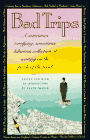
Bad Trips, an anthology of travel disasters, is a pretty good book, though given the great potential of its subject it could have been better. Once you get past the cover (it took three designers to make it look like a second-rate spy thriller from the '50s) and the title, with its dated, druggy double entendre, there's a lot to enjoy here.
I was happy to find selections from a number of writers I know and admire, including Joseph Brodsky, Edward Hoagland, John Updike, Paul Theroux, James Fenton, J.M. Coetzee, Graham Greene, Redmond O'Hanlon, Eric Newby, and Peter Matthiessen. There were also some intriguing pieces by writers I'd been aware of but hadn't yet read. Among the standouts were Ted Conover's adventures among the hoboes, Jonathan Raban's encounter with a crazed man in a Louisiana bar, and Mary Morris's deeply felt response to a death in Mexico. Few women are represented -- seven selections out of 50 -- but this says more about the scarcity of women travel writers, and the hazards that prevent women from travelling in many parts of the world, than it does about the selection process.
The editor is Canadian, and it was a pleasant surprise to see that the work of unfamiliar Canadian writers like George Woodcock and Mark Abley stood up quite well alongside the better-known Americans and Britons. An exception was the insufferable P.K. Page, one of those travellers who combine a love of landscape ("the familiar vistas of flat grassland with its underpainting of Venetian red") with contempt for the people who live in it, including "abos," "picaninnies," and one man who, in the extreme heat of the Australian outback, was uncivilized enough to have a beer with his shirt off. Horrors!
The excerpts are mostly quite short, and once I began to appreciate the distinctive voice of one writer it was jarring to break off and start reading someone else. This, though, is a drawback of any anthology. At least six or eight of the selections seemed expendable, whether because the writing was weak, because they didn't really address the subject of the bad trip, or because they were plainly works of fiction, not just true accounts told with fictional techniques. Meanwhile, some of the writers who cry out for inclusion were unaccountably missing. Where was V.S. Naipaul? Where was Bruce Chatwin, especially his chilling story of being detained during a West African coup? Where was The Fearful Void by Geoffrey Moorhouse, Edmund Wilson's Europe Without Baedeker, or even P.J. O'Rourke's Holidays in Hell? Where was Ryszard Kapuscinski, who has travelled to some of the worst places in the world, at the worst times, and written about them brilliantly?
And above all, where was The Worst Journey in the World, Apsley Cherry-Garrard's wonderful/horrible book about the ill-fated Scott expedition to Antarctica? George Woodcock mentions the book in his own piece, and so does the editor in his introduction, but no excerpt is included.
When I read The Worst Journey in the World a couple of years ago, I copied out the following passage. Quoted from a letter by a man named "Birdie" Bowers, it describes the predicament of Bowers' scouting party after the ice they had camped on broke up and they found themselves surrounded by killer whales. The letter provides a classic example of a low-key response to a trip gone seriously wrong.
The killers were too interested in us to be pleasant. They had a habit of bobbing up and down perpendicularly, so as to see over the edge of a floe, in looking for seals. The huge black and yellow heads with sickening pig eyes only a few yards from us at times, and always around us, are among the most disconcerting recollections I have of that day. The immense fins were bad enough, but when they started a perpendicular dodge they were positively beastly. As the day wore on skua gulls, looking upon us as certain carrion, settled down comfortably near us to await developments.
"Disconcerting," indeed. If I ever get the chance to edit a collection like Bad Trips, this passage will be in it.
Published in the Harvard Post, December 20, 1991.