


The Island of the Colorblind
by Oliver Sacks. Alfred A. Knopf, 1997. 298 pages, $24
Travelers have many reasons for visiting tropical islands. Neurology is not usually one of them. But for Oliver Sacks, author of The Man Who Mistook His Wife for a Hat, neurology has a compelling, even a romantic attraction.
The Island of the Colorblind, Sacks' latest book, is really about two islands, both in the Pacific. On the island of Pingelap, genetic isolation has allowed a recessive gene for colorblindness to proliferate until an estimated 8-10% of the population is entirely colorblind. And on Guam, a mystery disease, which causes progressive degeneration of the nervous system, continues to baffle researchers.
Sacks travels to Pingelap with Knut Nordby, a Norwegian vision physiologist who is himself colorblind, and the colorblind children of the island immediately recognize him as one of their own. "It was an odd sort of encounter which the rest of us were witnessing -- pale, Nordic Knut in his Western clothes, camera around his neck, and the small brown achromatopic children of Pingelap -- but intensely moving." Because their achromatopsia -- the technical term -- is due to a lack of color-receiving cones in the eyes, the affected people of Pingelap not only cannot perceive color, they also cannot tolerate bright light. Sacks and Nordby bring dark goggles that help the islanders function in daylight, but they also come to realize that a lack of color is in some ways a positive advantage. The colorblind are extraordinary night fishermen and botanists, keenly aware of the textures, shadings, and smells that distinguish one plant from another, when most people notice only a riot of green.
In the second half of his book, Sacks turns his attention to a complex neurological riddle that is still unsolved. The Chamorros, inhabitants of the island of Guam, have for many years suffered from a disease called lytico-bodig, whose symptoms are tremors and progressive paralysis that leaves its victims in a statue-like state of catatonia. Yet, like the patients Sacks described in Awakenings, who suffered a similar paralysis after recovering from encephalitis, the victims of lytico-bodig can sometimes be freed from their rigidity as if by magic. Though unable to initiate actions, some can answer questions that are put to them, or catch a thrown ball. And like the patients of Awakenings, they sometimes gain a sudden, though temporary, relief from their condition when treated with the drug L-DOPA.
Guam is home to the cycad tree, a "living fossil" that resembles a concrete pillar with fronds. In the past, during times of scarcity or because they liked the distinctive taste, the Chamorro people of Guam ate a flour called fadang that was made from the seeds of the cycad. Some researchers have proposed that the cycad might be an important factor in causing lytico-bodig, and Sacks describes the frustrating reversals in which new evidence has alternately destroyed and resurrected this theory.
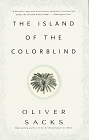
The Island of the Colorblind sometimes resembles the work of a Victorian naturalist, even to the old engraving of the cycad tree on the jacket and the ornately old-fashioned type inside. In his preface, Sacks recalls the childhood friends who shared his enthusiasm for the voyages of Darwin and Humboldt. Like the Victorian explorers, Sacks pursues the exotic with a warmth that sometimes borders on the sexual:
I was delighted to see ferns of all shapes and sizes, from the lacy, triangular fronds of Davallia, and bristly Pyrrosia sheathing the trunks of the pandanus, to the gleaming shoestring fern, Vittaria, which seemed to hang everywhere. In moist, protected areas we saw a filmy fern, Trichomanes, which excited me, not just because of its delicacy and beauty, but because Safford, in an uncharacteristic error, had written that there were no filmy ferns on Guam ... We came upon the rare Ophioglossum pendulum, an immense ribbon fern with great succulent fronds, rippling and forking as they descended from the crotch of a tree.
All of Oliver Sacks' books are personal, but The Island of the Colorblind, with its childhood reminiscences, descriptions of idyllic island scenes, and even an account of a hallucinatory trip on a local drug, is more personal than most. Though it doesn't showcase his diagnostic insights as well as his collections of case studies do, it is a winning introduction to his eager yet incisive personality and prose style.
Published in the Harvard Post, July 25, 1997.