


Faith in a Seed
by Henry D. Thoreau. Island Press, Shearwater Books, 1993. 284 pages, $25.00
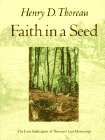
The trouble with a classic book like Walden is that it becomes too familiar. By now we are all pretty tired of hearing that the mass of men lead lives of quiet desperation, that we should beware of all enterprises that require new clothes, and that the sun is but a morning star.
Faith in a Seed, described as the first new book by Thoreau to appear in 125 years, reminds us of the vividness and originality of Thoreau's mind and language. Handsomely designed, supplied with a helpful map, and illustrated with engravings by Abigail Rorer and scratchy sketches by Thoreau himself, it is a welcome addition to his published writings.
Though Faith in a Seed is an unfinished work, with a loose weave and some dull passages, it contains more than enough humor, flights of fancy, and illuminating paradoxes to refute the notion that Thoreau's late writings were no more than scientific drudgery. Sometimes, in fact, it reads like an alternate version of Walden. "The mass of men," he says, "are very easily imposed on. They have their runways in which they always travel and are sure to fall into any pit or trap which is set there." And just as Thoreau noted in Walden that the cost of a thing is the amount of life that must be exchanged for it, in Faith in a Seed he says, "The value of any experience is measured, of course, not by the amount of money, but the amount of development we get out of it."
The book-length manuscript "The Dispersion of Seeds," which Thoreau was expanding and revising even while he was dying of tuberculosis, makes up the bulk of Faith in a Seed. Some passages read like raw field notes or journal excerpts, while others are fully developed. The manuscript thus provides a snapshot of Thoreau's writing methods, as well as a colorful picture of his detective work in the field and many examples of his almost superhuman ability to pay attention.
Thoreau's sense of humor, sometimes overlooked by readers, comes out delightfully and sometimes self-deprecatingly. Climbing a pine tree to gather the "pickle-like" curved cones, he finds that "I am in a pickle when I get one."
The cones are now all flowing with pitch, and my hands are soon so covered with it that I cannot easily cast down my booty when I would, it sticks to my fingers so; and when I get down at last and have picked them up, I cannot touch my basket with such hands but carry it on my arm, nor can I pick up my coat which I have taken off unless with my teeth -- or else I kick it up and catch it on my arm. Thus I go from tree to tree, rubbing my hands from time to time in brooks and mudholes in the hope of finding something that will remove pitch, as grease does, but in vain. It is the stickiest work I ever did; yet I stick to it.
But despite the humor, Thoreau has a serious intent in "The Dispersion of Seeds" -- to explain why oaks should spring up where pines have been cut down, to disprove the idea that plants ever grow without seeds, through spontaneous generation, and to describe the many ways seeds are spread by wind, birds, and animals. He accomplishes all this with an economy and precision that are literary as well as scientific virtues.
Even in this last period of Thoreau's career, and even while he was battling sickness, Thoreau remained a Transcendentalist, with a mind that readily drew connections between the humble and the cosmic. "If we suppose the earth to have sprung from a seed as small in proportion as the seed of a willow is compared with a large willow tree," begins one dizzying example, "then the seed of the earth, as I calculate, would have been equal to a globe less than two and a half miles in diameter, which might lie on about one-tenth of the surface of this town."
Somewhat farther in the book came a sentence that jarred me. "I have no time to go into details," Thoreau writes, "but will say, in a word, that while the wind is conveying the seeds of pines into hardwoods and open lands, the squirrels and other animals are conveying the seeds of oaks and walnuts into the pine woods, and thus a rotation of crops is kept up."
No time to go into details? When had Thoreau not had time to go into details? This was the man who examined the scratches on a chestnut with a microscope, then compared them with the teeth of a deer mouse, "whose skeleton I chanced to have." This was the man who, in Walden, told of an artist who carved, polished, and ornamented a wooden staff with such single-mindedness that he stayed young while civilizations rose and fell around him. Then I remembered Thoreau's tuberculosis -- worsened by a cold he caught one December while counting tree rings on stumps -- and the thousands of pages of manuscript he left behind at his death, and I realized that when he said he had no time he was simply recognizing an unavoidable fact.
Published in the Harvard Post, May 28, 1993.