


Magic Prague
by Angelo Maria Ripellino, translated from the Italian by David Newton Marinelli, edited by Michael Henry Heim. University of California Press, 1994. 333 pages, $30.00.
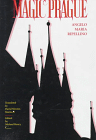
The title Magic Prague doesn't quite do justice to Praga Magica, an exhilarating, multifaceted work that has found its way into English twenty years after it was written and fifteen years after its author's death. "Magic," in English, has connotations of games for children, or tiresome card tricks. What we have here instead, disguised in a stodgy university-press jacket, is a highly original exploration of one of Europe's strangest cities.
The German poet Detlev von Lilencron, the author tells us, was convinced that he had led a previous life in Prague. "I too," says Ripellino, "am certain I once lived there."
Perhaps I arrived in the retinue of the Sicilian princess Perdita, who married Prince Florizel, the son of Polixenes, King of Bohemia, in Shakespeare's The Winter's Tale. Or as a student of the "ingegnosissimo pittor fantastico" Arcimboldo, who lived for many years at the court of His Imperial Majesty Rudolf II. I helped him to paint his composite portraits, those grotesque, disturbing faces bloated with warts and scrofula, which he contrived by heaping together fruits, flowers, ears of grain, straw and animals, as the Incas placed pieces of squash in the cheeks and gold eyes of their dead.
In these few lines you can get a glimpse of Ripellino's learning, the unexpected connections he draws (from Arcimboldo's composite faces to Inca burial customs), the interplay of historical and imaginary characters he creates, and his obsessive love for his subject. Ripellino, a poet, critic, and scholar of Czech and Russian culture, seems to have collected everything he knows about Prague into a single volume. And yet -- miraculously -- he rarely lets the book bog down. Much of what Ripellino is talking about will be unfamiliar, but because he never condescends to the reader, his erudition is engaging, not oppressive. We may not know exactly what is meant by nyctalopic nooks, apocalyptic marasma, or a gripe's egg, but the context gives us the general idea, and the whiff of mystery is not unwelcome.
"Listen closely," Ripellino says at once point, "for now you shall hear how Rabbi Loew fashioned the Golem." The Golem -- a humanoid sculpted from clay and given life by the Hebrew characters inscribed on its forehead -- is one of Prague's central myths, and an important point of connection for Magic Prague. Ripellino deftly brings out the various meanings of the Golem legend, linking it to the Prague fascination with tailors' dummies, waxwork figures, and marionettes. The robots of Karel Capek's play R.U.R. come from this tradition, as do the somnolent characters in Bruno Schulz's stories who all but turn into pieces of furniture, and the disturbingly organic clockwork creatures in the animated films of the brothers Quay.
Of the many writers who have lived in and written about Prague, Ripellino devotes most attention to two: Franz Kafka and Jaroslav Hasek, author of The Good Soldier Svejk. Ripellino has a keen appreciation for the very different talents of these two men: the "sober and precise, monodic, crystal-clear writing" in The Trial, which he calls "the most Prague-like of all Czech and German novels," as well as the scatological slapstick of Svejk and the vein of cruelty and desperation that lies underneath. Other writers are treated less kindly. Scenes of Prague appear in Rilke's verse, he says, "as in gaudy barrel-organ paintings." He describes one novel as "a creaky hearse," and another as "the highest achievement of Prague horror-tale kitsch."
Early in his book, Ripellino writes, disingenuously,
This compendium of Prague-related obiter dicta is incoherent and confused, written in uncertainty and poor health, with despair and constant second thoughts, with the infinite regret of not knowing everything, not embracing everything, because a city, even if only the setting for a fond flânerie, is a terrible, elusive, highly complex entity. This is why my narrative will lurch along like the old films they used to show at the Bio Ponrepo, Prague's first cinema, located in The Blue Pike santán. It will be flawed with breaks and jolts and gaps and attacks of heartache, like the music of Charlie Parker's alto sax. On the other hand, as [the poet Vladimir] Holan states, "have you no contradictions? You have no possibilities."
For anyone who has wanted to explore Kafka's Castle, look out over a medieval skyline of cupolas, turrets, and chimney pots, or walk the streets where alchemists and mountebanks sold mandrake roots and mysterious powders, Magic Prague is indispensable.
Published in the Harvard Post, March 11, 1994.