


A Parrot Without a Name:
The Search for the Last
Unknown Birds on Earth
by Don Stap. Alfred A. Knopf. 239 pages, $19.95.
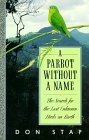
To write this book, the author joined John O'Neill and Ted Parker, two of the world's leading ornithologists, on expeditions into the Peruvian rainforest. Paddling up shallow jungle rivers in dugout canoes, or threading narrow forest paths where a moment's carelessness could make them hopelessly lost, they went in search of such birds as the razor-billed curassow and the buff-throated foliage-gleaner, and in the hope of discovering a bird that no one had ever seen or named before.
O'Neill and Parker, both of Louisiana State University, know more about "neotropical avifauna" than perhaps anyone else in the world. O'Neill has journeyed through the tropics of the New World, published many papers on his findings, and described more new species of birds than any other living ornithologist. His paintings of birds are both accurate and beautiful. But it is Parker who, despite a lack of advanced degrees, an impatience with the drudgery of writing up his work, and an aversion to killing birds in order to study them, has become "the leading authority on the birds of Peru, if not all of South America." The description of Parker's rapt absorption as he stalks a rare bird, recording its song on a portable tape recorder and then luring the bird closer with its own music, is enthralling. We sense Parker's thrill in the presence of these strange, beautiful, little-known birds.
Some of the facts about rainforests that Don Stap relates have become better known since 1988, when a ferociously hot summer and the murder of the Brazilian labor leader Chico Mendes made it clear to the world that millions of acres of rainforest were being slashed and burned, and that the fires were probably a major contributor to global warming. "Forty to fifty percent of all plants and animals live in tropical rainforests," says Stap, "though rainforests cover less than 2 percent of the planet." How important to us is this fantastic pool of biological diversity? "The odds are one in four that a prescription drug we take is directly or indirectly derived from a rainforest plant, and 70 percent of the three thousand plants identified by the United States Cancer Institute as having anticancer properties are from the rainforest." Once a tropical rainforest is destroyed, biologists say, it may take a thousand years before it completely replaces itself.
But it is not these alarming facts that make A Parrot Without a Name such a strong case for preservation. It is the skill with which Stap evokes the beauty and mystery of the rainforest world, in passages like this one, describing nightfall on the Rio Napo:
The water was hammered bronze. The boat was turning slowly around in the current, a ballet on river water which was itself moving across the continent on a planet that was revolving in the deep blue-black of space. In five minutes it was too dark to see the birds on the island, but many were crossing above us. A sickle of a moon grew sharper. We drifted past a starkly beautiful graveyard of deadwood caught on a sandbar. Daylight had edged into early night.
By the end of the book we feel that the loss of this world would be a tragedy.
Published in the Harvard Post, January 25, 1991.